


Image
For many households, running the air conditioning isn't just about comfort anymore — it's a calculated financial decision. Do you deal with the higher electric bill, or do you tough it out through a hot night and hope for the best?
To find out how widespread that trade-off really is, we surveyed 3,011 adults from households earning below $49,999 a year about how often they switch off their air conditioning at night to save money. We then combined that data with the U.S. Census Bureau's 2023 Local Air Conditioning Estimates to build a state-by-state picture of the problem.
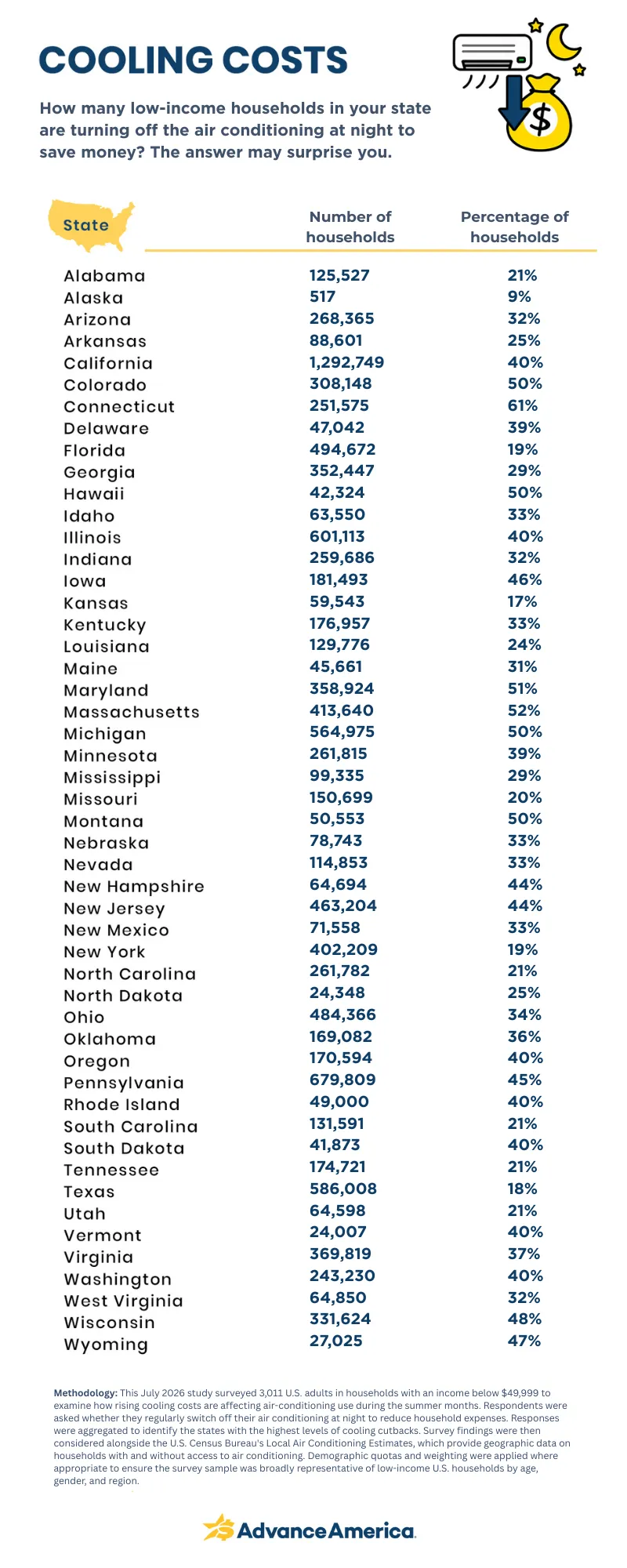
The result: more than 1 in 3 low-income households regularly turn off their air conditioning to cut costs — roughly 12.7 million households nationwide. On average, those households go 11 nights per month without any cooling at all.
Connecticut has the highest rate in the country, with 61% of lower-income households switching off their AC to save money. But Connecticut is a small state, so that only translates to about 251,575 households.
California's rate is much lower, 40%, yet its sheer population size means nearly 1.3 million households are affected — more than five times Connecticut's total.
California alone makes up close to 1 in 10 affected households nationally. We're talking about an estimated 1,292,749 lower-income California households that regularly go without AC to save money. No other state even comes close to 700,000.
Texas sits at 18%, Florida at 19%, Alabama at 21%, and Louisiana at 24% — all below the national average. At first glance, that might seem surprising. But in places where triple-digit heat is just part of summer, turning off the AC may not be an option, no matter how tight money gets.
Financial strain around cooling costs isn't limited to the Sun Belt. Connecticut, Massachusetts, Michigan, Montana, Wisconsin, and Iowa all rank near the top. Households in these regions may simply be less prepared for sustained heat, so even a shorter hot spell forces hard choices.
The most striking takeaway is this: it’s not a heat-map problem. Several Southern states fell below the national average, while states across the Northeast, Midwest, and Mountain West ranked among the highest. That doesn't mean heat is less of a threat in the South; more likely, Southern households have little choice but to keep the AC running because the heat doesn't let up.
Outside the South, people may try to tough it out because the worst heat comes and goes, even though those occasional stretches can still be dangerous.
Housing quality, electricity rates, local income levels, insulation, and familiarity with heat waves can all shape how a household responds. What the data really points to is an affordability problem, not a climate one.
“Keeping a home at a safe and comfortable temperature should not require families to fall behind on another bill, drain their savings or spend night after night unable to sleep.”
Respondents were also asked what they would give up for one month to afford air conditioning during an especially hot summer.
Takeout meals were the most expendable luxury, selected by 31% of those surveyed. New clothes came second at 19%, followed by streaming subscriptions at 17%.
The full breakdown:
While most respondents chose discretionary spending, the fact that 6% would dip into their savings illustrates how essential air conditioning has become during periods of extreme heat.
“Keeping a home at a safe and comfortable temperature should not require families to fall behind on another bill, drain their savings or spend night after night unable to sleep,” Laura McCutcheon, VP of Marketing at Advance America. “Yet these findings show that millions of lower-income households are being forced to calculate exactly how much cooling they can afford.”
“What may look like a small adjustment to the thermostat can have consequences that extend far beyond comfort. It can affect sleep, concentration, workplace performance, and even family relationships. As summer temperatures rise, cooling costs are becoming an increasingly significant part of the financial pressure facing American households.”
No single number tells the full story. Connecticut has the highest share of households cutting back. California has, by a wide margin, the most households affected. Texas has one of the lowest rates in the country and still has more than half a million households going without.
Put it all together, and cooling is becoming one more measure of financial security. As summers get hotter and energy bills climb, whether a family can safely keep their home cool is starting to reflect how much financial breathing room they have.
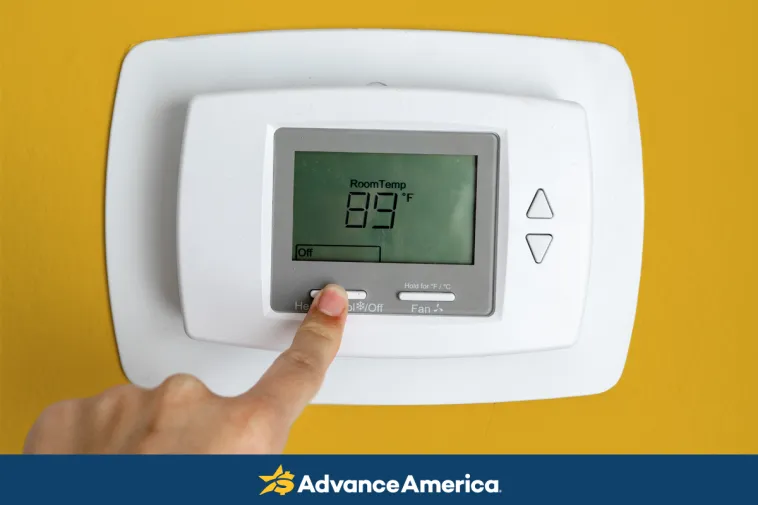
Punching the thermostat takes a second. Deciding whether you can afford to is a lot more complicated.
Methodology
This study surveyed 3,011 respondents in households with an income below $49,999 across the U.S. in July 2026 to examine how rising cooling costs are affecting air-conditioning use during the summer months. Respondents were asked whether they regularly switch off their air conditioning at night to reduce household expenses. Responses were aggregated to identify the states with the highest levels of cooling cutbacks. Survey findings were then considered alongside the U.S. Census Bureau’s Local Air Conditioning Estimates, which provide geographic data on households with and without access to air conditioning. Demographic quotas and weighting were applied where appropriate to ensure the survey sample was broadly representative of low-income U.S. households by age, gender, and region.
1. United States Census Bureau: Local Air Conditioning Estimates
Notice: Information provided in this article is for informational purposes only. Consult your attorney or financial advisor about your financial circumstances.
 About the author
Jennifer McKnight is the Senior Content Writer at Advance America, where she turns complicated financial topics into plain, helpful content. She's here to make sure you have what you need to feel informed and confident when it matters most.