



Image
Fruit and vegetable prices rose 6.1% from April 2025 to April 2026. 1 For many families, inflation is affecting more than just shopping habits — it’s influencing what ends up on the dinner table.
We surveyed 3,004 U.S. shoppers to find out how rising produce prices are reshaping what people buy, what they skip, and how they feel about it.
Key Takeaways
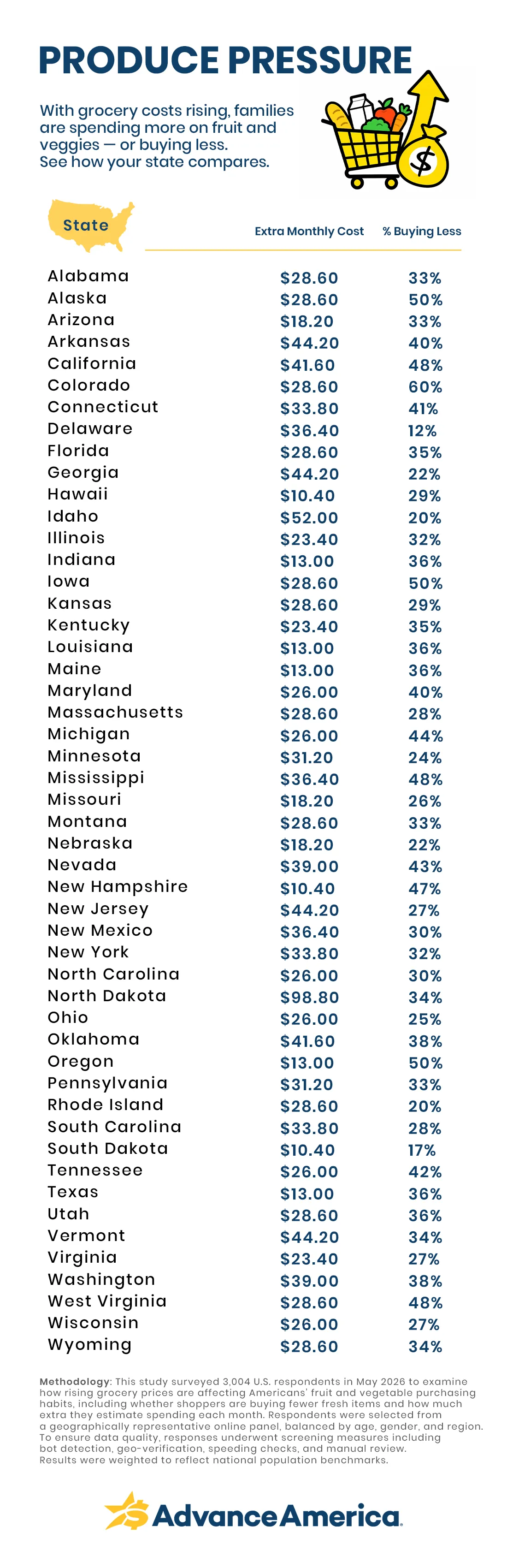
Colorado leads the nation, with 60% of families saying they're buying fewer fruits and vegetables each week. Alaska, Iowa, and Oregon follow at 50%, with Mississippi and West Virginia close behind at 48%. The variety spans high-cost-of-living states, rural communities, and lower-income households. Budget pressure doesn't follow a map.
At the other end, Delaware has the lowest share at 12%, followed by South Dakota at 17% and Idaho and Rhode Island at 20%. Families there still feel the pressure, but they're less likely to cut back on produce.
The real story isn't the price of nutritious food options in each state. It's about how much room families have left in the budget when those prices rise, and what they do about it. In some households, a few extra dollars are an inconvenience. In others, it changes the entire shopping trip.
The substitutions tell an important story. One in five families has bought more frozen fruit or vegetables over the past year to reduce costs. Frozen produce often costs less and lasts longer, which can also reduce food waste.
Fewer shoppers (9%) have turned to canned produce, while another 9% have stopped buying certain fruits altogether.
Not every change is dramatic. 6% of families say they've chosen cheaper processed foods over fresh produce, and 4% have switched to less expensive varieties. These are quiet adjustments that reflect real pressure on the household budget.
Among parents, 3% say they've skipped produce for themselves but kept buying it for their children. It's a small percentage, but it represents millions of parents making that call every week.
Produce is supposed to be a staple. When it starts feeling like a luxury, the frustration goes beyond the receipt.
When asked how rising produce prices makes them feel, 40% of respondents said frustrated, and 25% said angry. Another 8% said they're concerned about their own health, and 3% are worried specifically about their children's diet. 64% say they worry at least occasionally that their diet is less healthy because of grocery costs, including 24% who worry frequently. That's not just a shopping preference. It's a quiet worry that follows families into the store every week.
When asked which statement best reflected their current view, nearly one in three (28%) families said healthy eating is becoming financially unrealistic for them. A further 30% said they still try to eat healthily, but compromise more often now.
Only 19% said they continue to prioritize healthy eating no matter the cost, while 15% said grocery prices haven't changed their habits at all. For the majority, the produce aisle isn't just more expensive — it's a trade-off they can't always win.
51% of families say their overall diet is less healthy than it was two to three years ago because of grocery prices. For many households, this isn't a one-off expensive month. It's a shift that's been quietly building.
The data doesn't suggest families have stopped caring about what goes in their cart. It suggests the opposite. They're comparing prices, switching to frozen, and in some cases buying produce for their children before themselves.
The grocery compromise isn't always dramatic. It's skipping the berries. Buying frozen instead of fresh. Stretching the salad one more day. These small adjustments reflect real budget pressure, not a lack of effort.
Produce prices matter because fruits and vegetables are supposed to be the sensible choice. When families start cutting back there, it says something bigger about the state of the household budget.
Methodology
This study surveyed 3,004 U.S. respondents in May 2026 to examine how rising grocery prices are affecting Americans’ fruit and vegetable purchasing habits, including whether shoppers are buying fewer fresh items and how much extra they estimate spending each month. Respondents were selected from a geographically representative online panel, balanced by age, gender, and region. To ensure data quality, responses underwent screening measures including bot detection, geo-verification, speeding checks, and manual review. Results were weighted to reflect national population benchmarks.
1. U.S. Bureau of Labor Statistics: Consumer Price Index
Notice: Information provided in this article is for informational purposes only. Consult your attorney or financial advisor about your financial circumstances.
 About the author
Jennifer McKnight is the Senior Content Writer at Advance America, where she turns complicated financial topics into plain, helpful content. She's here to make sure you have what you need to feel informed and confident when it matters most.