



Image
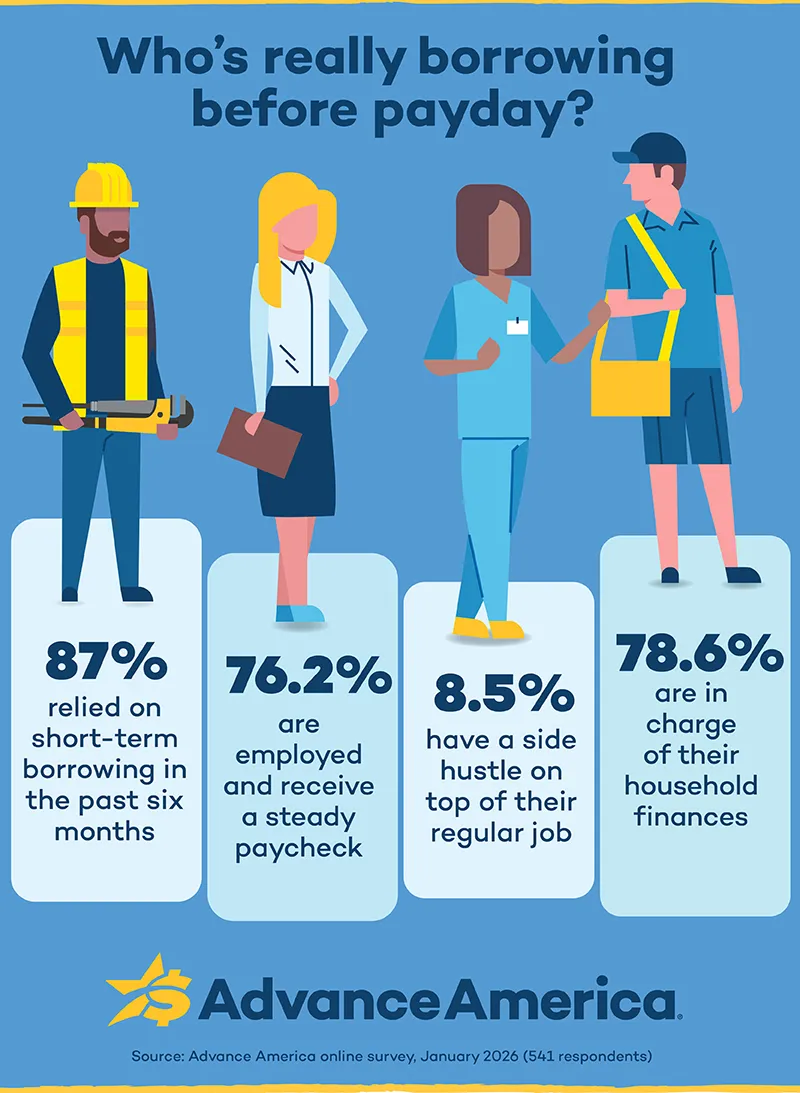

In a 2026 survey conducted by Advance America, 87% of people said they'd used at least one short-term borrowing method to access cash before their next payday — and 76% had a regular paycheck coming in.
These respondents aren't between jobs. They're working Americans managing the gap between when the bills come due and when the money does.
That gap has only widened since. By August 2026, U.S. inflation had risen to 3.4% year-over-year while average hourly earnings decreased 0.3%, according to the Bureau of Labor Statistics.
A steady job still matters. It just doesn't buy as much as it used to.
Advance America's survey, conducted in January 2026 with 541 respondents, set out to understand how people are managing short-term financial needs. The results challenge a persistent myth: that people who turn to payday loans or cash advances are unemployed, financially irresponsible, or out of options.
Here's what the data showed:
Roughly 80% of survey respondents fell between the ages of 35 and 54. These aren't people on the margins of the workforce. They're employed adults, many of them with mortgages, kids, and bills that don't wait.
The issue isn't income. It's timing.
According to CNN Business, April 2026 marked a turning point: for the first time in three years, Americans' wages were no longer outpacing inflation. Wages grew 3.6% that month, while inflation hit 3.8%.
"A substantial number of Americans are worse off," Heather Long, chief economist at Navy Federal Credit Union, told CNBC. "Their incomes are not keeping up with the price increases right now."
Everyday costs are the key drivers. Gas prices rose more than 27% year-over-year in August, while diesel hit $6 per gallon (a record high). Food prices, airfare, and consumer electronics have all gone up, too.
These factors aren't abstract economic data. Those extra costs show up in the weekly budget, in the gap between what a paycheck used to cover and what life costs now. And it helps explain why so many working adults are still coming up short before payday.
Payday sets a rhythm, but everyday costs have fallen out of step.
It's not even about the car breaking down before payday; it's about how much more it costs to fill the tank. Or reach that deductible. Or afford fresh produce.
And we're not the only ones taking note.
According to a CNBC Affordability Survey (July 2026), 63% of Americans are living paycheck to paycheck. And 61% of them say their pay schedule doesn't align with the timing of their expenses. As a result, 44% have incurred late fees, interest, or bank overdraft charges in the past six months simply while waiting for their next paycheck to arrive.
When that paycheck gap widens, people reach for whatever tool fits the moment. Advance America's survey found that among those who accessed cash before payday:
Each of these options carries its own costs and trade-offs. Overdraft fees add up fast. Borrowing from family can strain relationships. Cash advance apps vary widely in transparency. A payday loan or installment loan, when used intentionally, can be the straightforward, predictable option — if you know what you'll owe before you sign.
There's a tendency to frame short-term borrowing as a symptom of financial dysfunction. But our survey data suggests something different: it's a practical response to a structural problem.
When 87% of survey respondents have used a short-term cash method, and most of them have steady jobs, the story isn't about irresponsibility. It's about a gap that exists for millions of working Americans, and the tools they're using to close it.
Here's how the most common short-term borrowing options compare:
| Option | How it works | Best for |
|---|---|---|
| Payday loan | Short-term, small-dollar loan repaid in full on your next payday. | Smaller, one-time gaps. |
| Installment loan | Fixed amount repaid over a set schedule of payments. | Larger needs or when you want more time to repay. |
| Line of credit | Take what you need up to your approved limit. Access available funds again as you repay. | Recurring cash flow gaps. |
| Cash advance app | Access a portion of your earned wages before payday, typically for a small fee or tip. | Small, frequent gaps when you've already earned money but haven't been paid yet. |
| Friends or family | Borrowing directly from someone you know, typically with no formal terms, interest, or repayment schedule. | When you have a trusted relationship and an agreement to repay. |
Whatever option you're considering, the right move is to understand the full cost before you borrow, confirm you can repay on schedule, and choose the product that fits your actual situation — not just the one that's fastest.
If you're navigating a paycheck gap right now, you're not alone. And you're not failing. You're doing what working Americans have always done: finding a way to make it work.
Advance America conducted an online survey in January 2026 among 541 U.S. adults recruited through the company's digital marketing channels. Respondents were asked about their short-term borrowing behaviors in the prior six months, mobile app usage for cash advances, income sources, household financial management responsibilities, and demographic characteristics. Participants were located across multiple states, with concentrations in Florida, Texas, and other markets where Advance America operates. Results reflect the experiences of adults familiar with Advance America and may not be representative of the broader U.S. population.
CNBC | "Inflation Is Outpacing Wage Growth Again, Squeezing Americans' Paychecks"
CNN | "US Inflation Rose to 3.8% in April, Eroding Americans' Paychecks"
SurveyMonkey | "CNBC and SurveyMonkey Quarterly Money Survey: Affordability"
U.S. Bureau of Labor Statistics | Real Earnings and Consumer Price Index Summary
Notice: Information provided in this article is for informational purposes only. Consult your attorney or financial advisor about your financial circumstances.
 About the author
Jennifer McKnight is the Senior Content Writer at Advance America, where she turns complicated financial topics into plain, helpful content. She's here to make sure you have what you need to feel informed and confident when it matters most.